
The Rising Cost of Getting Flowers to Ireland
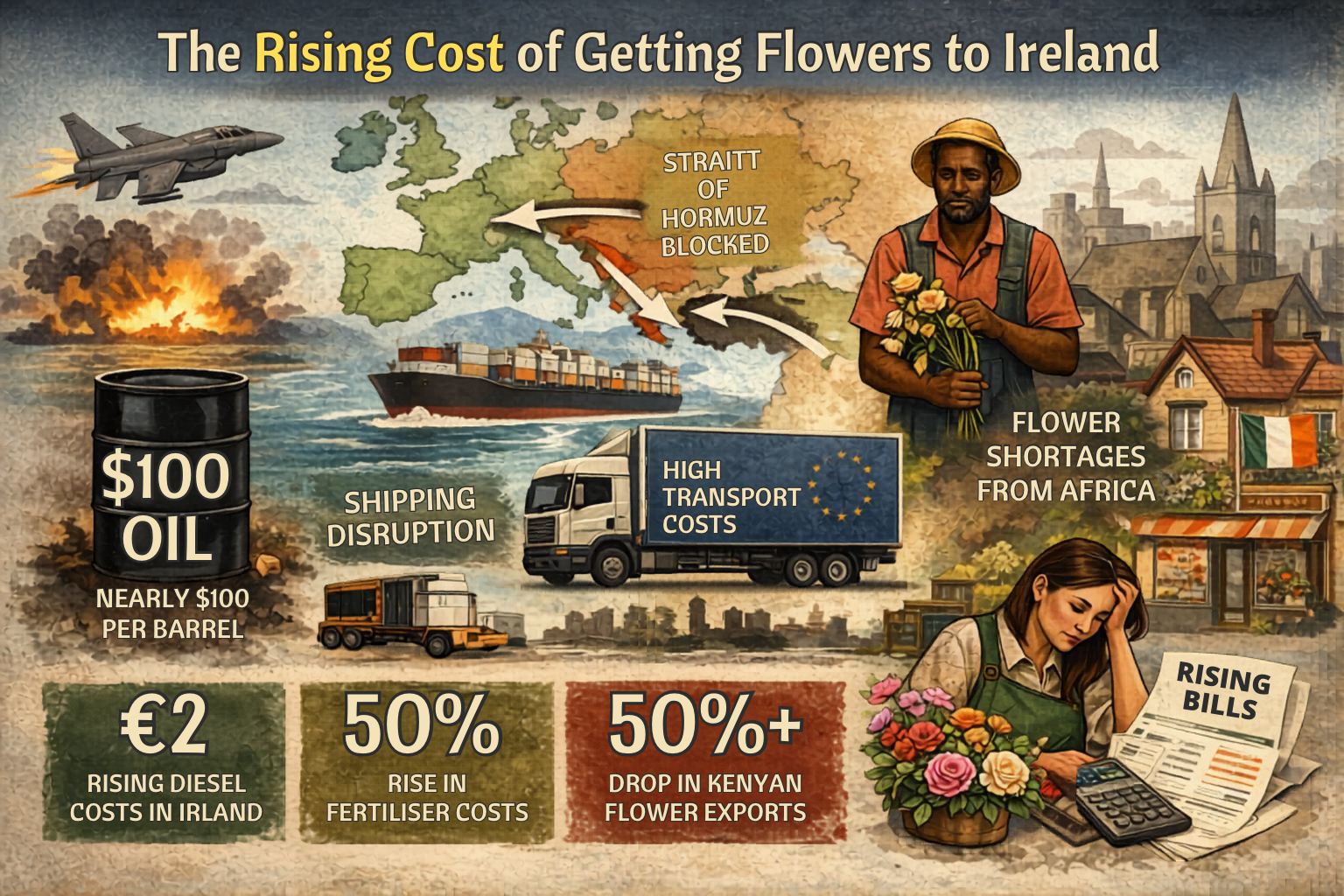
A war in the Middle East, oil at nearly $100 a barrel, and a global shipping crisis are hitting the flower trade hard. Here is what every Irish florist needs to know right now.
If your flower bills have felt heavier lately, you are not imagining it. And if you have not felt it yet, you will soon. A series of events happening thousands of miles from Ireland are working their way through the global supply chain, and they are heading straight for every florist's bucket and every customer's bill.
At the Institute of Flowers, we think it is our job to tell you what is happening plainly and honestly, before it catches you off guard. So here it is.
What Has Happened
On 28 February 2026, the United States and Israel launched military strikes on Iran. Iran retaliated almost immediately — including by taking control of the Strait of Hormuz, the narrow waterway that connects the Persian Gulf to the rest of the world's oceans.
You might be wondering what a waterway in the Middle East has to do with the roses in your cold room. The answer is: a great deal.
The Strait of Hormuz carries roughly 20% of the world's oil. Since the conflict began, shipping traffic through it has fallen from around 130 vessels a day to almost nothing. Oil prices have risen sharply to over $100 a barrel — up more than 50% compared to a year ago.
Oil is the fuel that moves everything. Trucks, ferries, refrigerated lorries, aircraft — the entire flower supply chain runs on it. When oil prices spike, transport costs follow, and those costs end up in your wholesale invoice.
How It Hits the Flower Chain
It is not one problem. It is several problems hitting at the same time, at different points in the chain from grower to your shop.
Diesel is more expensive across Europe
Ireland already has the most expensive diesel in the EU over €2 per litre, and the Net Every truck carrying flowers from Dutch auction houses to ferry ports is now burning more expensive fuel.
New Dutch tolls are coming in July
The Netherlands, the engine room of the European flower trade, is introducing a new kilometre-based toll system for heavy goods vehicles in July 2026. Denmark did the same thing recently and saw truck tolls rise by 500%. The cost of moving flowers out of Holland will go up again.
Fertiliser prices have shot up 50%
This is the less obvious one. Around a third of the world's fertiliser trade also passes through the Strait of Hormuz. The price of urea, the most widely used fertiliser in commercial growing, has risen from $482 per tonne before the conflict to $720 by mid-March. Dutch greenhouse growers and African flower farms all depend on it. When their growing costs go up, so do the prices at auction.
African growers are in crisis
Kenya and Ethiopia supply a huge proportion of the roses and other cut flowers that come through Holland to Ireland. Kenyan flower farms are reporting export volumes down by more than 50%, with losses of $1.4 million per week across the sector. Fewer stems available at auction means higher prices for everyone buying there.
Why Ireland Feels It More
Being an island is wonderful but it also means we pay more to get flowers here than almost anywhere else in Europe.
Every box of flowers arriving in Ireland travels further than it does to reach a florist in Germany, France, or Belgium. There is the truck from grower to Auction then from Auction in Holland to the ferry port. There is the two ferry crossing itself, fuel-hungry, and now more expensive. Then there is the delivery on this side. That is an extra cost baked into every stem, and it grows when diesel prices rise.
“We have almost no domestic flower production to fallback on. When imported flowers get more expensive or harder to come by, Irish florists have very few alternatives."
In countries like the UK, France, and the Netherlands, local growers can pick up some of the slack when global prices spike. In Ireland, our domestic growing sector, while growing thanks to dedicated people and the Slow Flowers movement, is still tiny compared to what we need. We are almost entirely dependent on what arrives from abroad.
What This Means for You
In plain language: your wholesale costs are going up. In some cases they already have. The pressure on margins will increase over the coming months unless something significant changes in the Middle East, and there is no sign of that yet.
This is not your wholesaler being greedy. This is not the auction being unfair. This is a genuine global cost shock running through the entire supply chain, and everyone in it is feeling the squeeze.
What you can do now?
Pricing
Review your prices
If your price list has not moved in six months, it probably needs to. Be honest with your customers. Most people understand that costs have gone up across the board
Lean into seasonal
Irish-grown flowers and foliage are not subject to the same transport costs. Growers like Tanners Foliage and members of the Flower Farmers of Ireland are worth building a relationship with now. We even have some lovely flower farmers among us in our community.
Communication
Talk to your customers
Share what is happening. People respond well to honesty. A short message explaining why prices have changed builds trust and it positions you as someone who knows their industry inside out.
Flexibility
Be flexible on stems
If a particular variety has become very expensive or unreliable, offer alternatives. Being a skilled florist means knowing what to use when the perfect choice is not available.
A note to our members. The IOF is tracking this situation closely. If you are struggling with the impact of rising costs on your business, we want to hear from you. Sharing what is happening on the ground helps us advocate for the trade and support our members better. Get in touch through circle or social channels.
The Bigger Picture
Situations like this remind us of something important: the global flower trade is remarkable, but it is also fragile. The roses in your window this week might have been grown in Kenya, flown to Amsterdam, bought at auction, loaded onto a refrigerated truck, put on a ferry, and driven across Ireland, all in the space of a week. That chain is extraordinary. It is also vulnerable to exactly the kind of disruption we are seeing now.
This is part of why the IOF has always believed that growing Ireland's domestic flower farming, alongside our connections to the global trade is not just a nice idea. It is a resilience strategy. Local growers are not a niche. They are part of how we build a more stable future for Irish floristry.
In the meantime, keep doing what you do. Irish florists are creative, resourceful, and deeply skilled. We have navigated difficult times before. We will navigate this one too, better, if we do it together.
